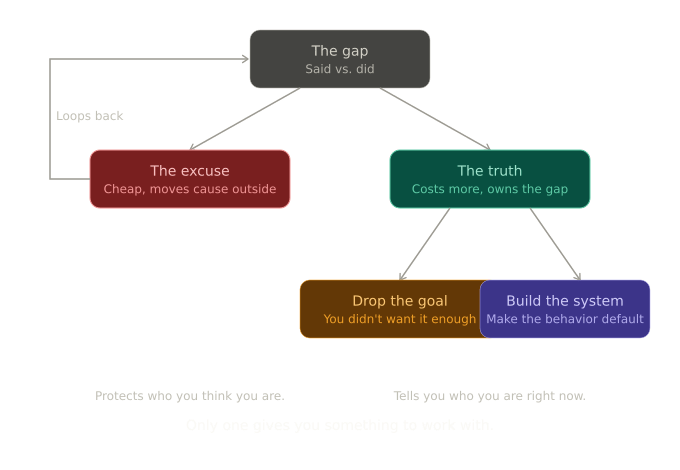
People don’t make excuses because they’re lazy. They make excuses because the excuse protects something the truth would expose.
Watch what an excuse actually does. “I didn’t have time.” “The timing was off.” “I would have, but.” Every one of them moves the cause outside the person. Time did it. Circumstance did it. The thing that got in the way did it. What none of them say is the real sentence: I wasn’t willing to do it.
That sentence is expensive. The excuse is free.
What the excuse is buying
Admitting you weren’t willing puts you on the hook. It means the gap between who you say you are and what you actually did is yours to own. The excuse buys distance from that gap. It lets you keep the identity intact while skipping the behavior.
I’ve done this. I told myself for years that I’d train more if my schedule opened up. The schedule opened up. I trained the same amount. The schedule was never the constraint. I just didn’t want it badly enough to build my week around it, and “no time” was easier to say than that.
The excuse wasn’t a lie about my calendar. It was a lie about my priorities, dressed up as a fact about my calendar.
Why willpower framing makes this worse
The standard answer here is to call it weakness. You’re soft. You lack discipline. Push harder, want it more, stop making excuses.
That framing is part of the problem. It turns the whole thing into a character flaw, and a character flaw is exactly what the excuse exists to avoid. So now the stakes of telling the truth are even higher, because the truth means admitting you’re the kind of person who’s weak. Of course people reach for the excuse. You’ve made honesty cost more than the lie.
I don’t think most unwillingness is a character flaw. I think it’s information. When I keep “not getting around to” something, that’s data. Either I don’t actually want the outcome, or I haven’t built anything that makes the behavior likely. Both of those are fixable. “You’re weak” fixes nothing.
The honest version
Try the trade. Instead of “I didn’t have time to train,” say “training wasn’t a priority this week.” Instead of “the timing was off on that project,” say “I wasn’t willing to do the work it needed.”
It feels worse to say. That’s the whole point. But it gives you something the excuse never does: an accurate read on what you actually want.
Half the time, the honest version ends the conversation. You say “I’m not willing to do that” and you realize you don’t want the outcome enough to pay for it, and you let it go. That’s not failure. That’s you stopping the lie about wanting something you don’t.
The other half, the honest version is the start of building. Because now you know the truth. You want the result, you’re not willing to do the thing, and willpower won’t close that gap because willpower never has. So you change the design instead. You make the behavior the default. You set the constraint so the right move is the only move. You build the thing that removes the need to be willing every single morning.
Where I land
The excuse protects who you think you are. The truth tells you who you actually are right now. Only one of those gives you something to work with.
I’d rather say “I wasn’t willing” out loud and feel the sting, because the sting is the signal. Either I drop the goal honestly, or I go build the system that makes the willingness unnecessary. Both beat carrying around a stack of reasons it wasn’t my fault.
Stop defending the gap. Name it. Then decide which one you’re doing about it.
===
It doesn’t make sense to continue wanting something if you’re not willing to do what it takes to get it.
If you don’t want to live the lifestyle, then release yourself from the desire. To crave the result but not the process, is to guarantee disappointment.— James Clear (@JamesClear) April 11, 2025
V/R,
Nick Hession-Kugelman

